
Breed History
Early Standard Schnauzer History
The Standard Schnauzer is the prototype of the Miniature Schnauzer and Giant Schnauzer. Since the Middle Ages, dogs similar in appearance to today’s Standard Schnauzers performed household and farm duties in Germany. The Standard Schnauzers in the 1400th to 1800th centuries in Europe protected and guarded the
family home and livestock; eliminated the farmyard unwanted, nuisance animals; and traveled with their owners to protect them as they went to Market. Standard Schnauzers are rough-haired, medium-sized dogs and descended from early European herding and guardian breeds.
In the 15th and 16th centuries the Standard Schnauzer was regarded to be in high popularity as a household companion since his portrait appeared in many
paintings, tapestry, and statues during this time. Albrecht Durer was known to have owned a Standard Schnauzer for at least 12 years. The portrait of his dog
occurred several times in Albrecht’s works between 1492 and 1504. In addition, Rembrandt painted several Schnauzers as well. In 1501, Lucas Cranach the Elder
displays one in a tapestry. Also in the 18th century, a Standard Schnauzer appeared in a canvas of the English painter Sir Joshua Reynolds. In Mechlenburg,
Germany’s marketplace there is a statue of a hunter dating from the 14th century with a Schnauzer crouching at the hunter’s feet which appears very closely
to today’s Standard Schnauzer.
In the 1870’s the Standard was originally known as the Wire-haired Pinscher and was first exhibited in Germany. The official German breed standard of that era
describes a dog remarkably like the Standard Schnauzer of today.
In the mid-19th century, the German dog fanciers began to take an interest in this highly intelligent, loving, and native breed. At this time, crosses were made
with the gray Wolfspitz and black German Poodle to produce the distinctive pepper and salt and black colors. At this time, the medium-sized dogs, as mentioned
above, were also being crossed with other breeds to develop the Miniature Schnauzer and later the Giant Schnauzer.
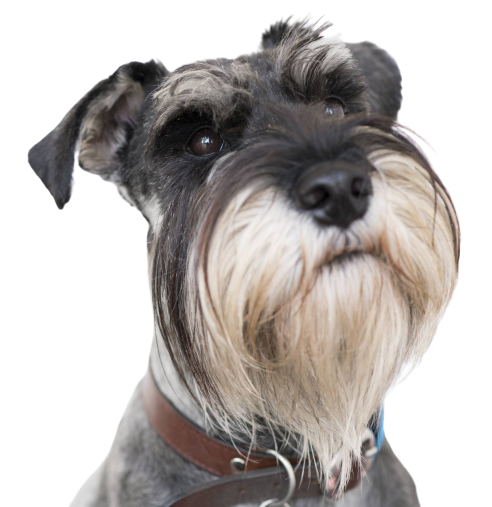
By the turn of the 19th Century, the breed was becoming universally known as the Schnauzer. The Standard Schnauzer’s hallmark is a muzzle (German: schnauzer)
sporting a long beard, moustache, and beautifully arched eyebrows which framed its very dark eyes which peer beneath the arched, white eyebrows.
General Appearance
The Standard Schnauzer is described as a robust, medium-sized dog with good muscle and plentyof bone. In addition, the Standard Schnauzer is squarely built in proportion of body length to height. It is ruggedly built with a dense, copper-wire harsh jacket(coat) when hand-stripped. This The Standard Schnauzer’s appearance
is accentuated by the Hallmark of the Breed: arched eyebrows, whiskers and beard.
This canine breed is the only one that has the breed description of “human-like brain.”
The Standard Schnauzer’s head is long and rectangular with a strong, pointed muzzle. The nose is black and the eyes are oval and very dark brown (ideally almost black).
Its feet are small and tightly packed like a cat with arched toes. At 3 days of age, the puppy’s tail is docked and the dewclaws on the front legs are usually removed by the Breeder or a Veterinarian. Usually the third day after birth the tail is docked and the dewclaws on the front legs are removed to eliminate any pain to the puppy since its nervous system is not fully developed until 5-1/2 weeks of age. If any of the litter of puppies are planned to have their ears cropped, this is usually done by the Breeder
at the puppies’ 8 weeks of age by an dog ear cropping specialist. It is important to note that the Breeder needs to schedule this specialized surgery about 30 days before the desired ear-cropped puppies are 8 weeks old.
It is extremely desirable that the coat of the body (jacket) be harsh, wiry, and dense while the undercoat remains soft. Also, the legs should have soft and long fur (furnishings) matching the soft, long beard, arched eye brows, and chest of the Standard Schnauzer. There are several colors of the Standard Schnauzer: Salt ‘n Pepper, Pepper ‘n Salt (most common), and solid black. We only produce the Pepper ‘n Salt color puppies.
Size and Proportion
Ideal height at the shoulder (withers) is 18-20 inches for the male and 17-19 inches for the females. Dogs measuring over or under these limits may be faulted if the Standard is entered in a dog show.
The weight of the Dog (male) ranges from 42 to 45 pounds and the weight of the Bitch (female) ranges from 32 to 35 pounds.
Temperament
As mentioned on our Home Page, Standard Schnauzers are intensely loving, devoted, and loyal dogs so they quickly bond strongly to their families. Centuries ago in
Europe, the Standard Schnauzer was bred to guard its family and home, and this guard dog trait currently remains in this breed. They will bark when a stranger appears
on the home front and alerts their family until the dog is certain of the intruder’s intention. Soon after the family dog is assured that the person will not be harmful to the family, the Standard Schnauzer will become friendly and settles down. Therefore, the Standard Schnauzer is a fearless and highly protective dog. In addition, this breed
is highly intelligent, clever, demanding, playful, lively and energetic. This breed is not a lap dog all day and requires daily exercise activities. Families who are active in walking, camping, hiking, water sports, fishing, and boating will find that the high energy Standard Schnauzer loves this high activity and fits right into the family.
Because the Standard Schnauzer is highly intelligent, they enjoy being challenged on-a-daily- basis. They have a high learning rate, but they are also willful and need
firm, but gentle training. The Owner(s) should have the ability to be firm, but lovingly in controlling the dog and clearly demonstrate who is the boss … obviously not
the dog. It is important during socialization of the puppy that the puppy is taught to submit to a human in training especially when the puppy may be biting or
overbearing with another puppy. Good temperament of the Bitch (female) and Dog (male) is a major consideration of the Breeder when planning a future litter.
With correct temperament and good socialization of the puppy commencing as early as 4-1/2 weeks of age in our kennel, the Standard Schnauzer makes a
wonderful family pet.
The Standard Schnauzer has excelled not only in the show ring, but also has exhibited its athletic abilities in Obedience, Agility, Rally, Barn Hunting, and Tracking
exercises and competition. In addition, they are successful in herding sheep, goats, and other animals. Also, they are now certified as search and rescue dogs as well
as cancer and blood sugar level detection (diabetes ketone levels) sniffing dogs. In addition, many Standard Schnauzers are also certified as Therapy and Service Dogs.
The Standard Schnauzer is often found in nursing homes, hospitals, and assisted-living homes where they comfort patients with love, attentiveness, and kindness.
Health Problems
The Orthopedic Foundation of America requires that Breeders have each Standard Schnauzer tested at 2 years or older for soundness of hips and eyes before using
them in a breeding program. This hip x-ray test clears any Standard Schnauzer of having hip dysplasia; and, of course, the eye test must be tested as Normal.
The Standard Schnauzer eye tests should be done annually. Many Breeders, like myself, also have the Heart, Elbows, and Thyroid testing (for Bitches) done as well,
but it is not required. With this approved rating of the hips and eyes, the Breeder can be selective about choosing the mate with the same approved testing (Hips should
be Good or Excellent and Eyes should be Normal). Any health testing done beyond the required health testing awards the Breeder of a CHIC Certificate; we fall into this category and have received many CHIC Certificates over the years for our females’ health tests which are not required by American Kennel Club.
I perform another very important health test of the Standard Schnauzer in which a swab of the dog’s mouth is done, and it is to clear the individual Standard Schnauzer
of a disease of the heart called Dilated Cardiomyopathy. When DCM test results are Negative/Normal, this eliminates a Breeder from producing Carriers of the disease or producing puppies with the disease. Proudly, I do NOT have any of my over 38 puppies being a Carrier of the disease or having the DCM Disease. Tracing the Stud Dog’s ancestors to study and document up to three to four generations of the Stud Dog’s health test results on Orthopedic Foundation of America website greatly helps me produce Standard Schnauzer puppies who are very, very healthy. Out of our 30 Adult Standard Schnauzers (8 puppies in 2024 not counted yet) not one of our of Standard Schnauzers has been diagnosed with cancer since the beginning of our dog business since 2008.
The Standard Schnauzer is a very healthy breed and lives from 12 to 16 years of age.
Non- Allergic Qualities
In the past, we have experienced allergies in our family and have discovered that the Standard Schnauzer possesses a near non-shedding coat. Unlike other dog
breeds, the Standard Schnauzer does not shed twice a year. With proper and regular grooming, there is very minimal shedding and very little noticeable hair or
fur in the household.
Grooming of your Standard Schnauzer is an important part of its maintenance and should be brushed several times weekly. In addition, the Standard Schnauzer
should be scheduled every 4 to 4-1/2 weeks to hand strip the jacket (coat) which is a process of removing the top layer of the coat (jacket), thereby thinning the
dense layers of the dog’s coat. This hand stripping is an unique grooming skill which requires a Certified Hand Stripping Groomer and not done at every groomer’s
salon. The hand stripping of the top layer of the dense jacket stimulates the underlayer next to the skin to transform the fur to coarse, wiry hair on the jacket of our dogs.
If an Owner elects not to hand strip its Standard Schnauzer, the Groomer can clipper their dog. This keeps the coat from shedding a lot as well, but there will be more
fur shed compared to a hand-stripped Standard Schnauzer. As mentioned above, several weekly brushing and combing of the jacket, furnishings and beard should be
done. Scheduling clipper and bathing appointments with the Groomer should be done no more than 4 to 5 weeks apart, depending on the slow or high jacket growth
of your Schnauzer.
Another great attribute of the Standard Schnauzer is that they have no “doggy” smell even when they grow older.
Summary
We look forward to hearing from you if you are interested in a Standard Schnauzer puppy. Please fill out our Contact Form so that we can contact you. Also, I recommend you research a book I published, Roman The Wonder Dog, which is about Roman, one of my Standard Schnauzers, who tells the young Reader about his life in Anchorage, Alaska with his two Owners. It was published as a softbound and hardbound book with 56 pages and 66 glossy photographs taken in Alaska by Renee, one of Roman’s Owners. Renee has entered many professional photographers’ contests and has defeated the professional photographers frequently. Each of these books can be found
on Archway Publishing’s online bookstore, and Amazon at this time. Also, Barnes & Noble can order my book upon request.